
David Deighton’s Approach to Active Listening, Art, and Bridging Human Divides
- David Deighton

- May 18
- 11 min read
David Deighton on Art, Politics, and the Power of Human Connection
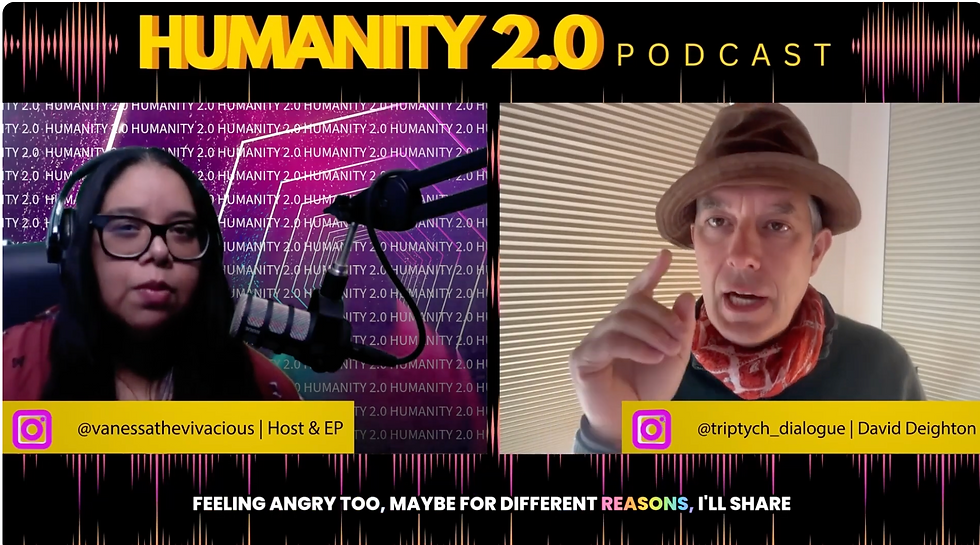
In this compelling podcast episode, abstract artist David Deighton reveals how his work moves beyond the canvas and into real-world human interaction—engaging strangers in conversations about one of the most polarizing topics: politics. Rather than avoiding division, Deighton steps directly into it, using art as a vehicle to create meaningful, non-confrontational dialogue in unexpected environments.
Listeners will gain a rare, practical framework for navigating disagreement, improving active listening, and rediscovering the power of presence in an age dominated by digital noise and AI-driven communication. This episode is essential for anyone interested in art, human connection, and the future of authentic conversation.
Key Takeaways
Art can function as a real-time tool for dialogue, not just visual expression.
Active listening—especially across disagreement—can dissolve conflict and create connection.
Environment plays a critical role in openness, with nature fostering deeper conversations.
Simple practices are more effective than complex theories in bridging human divides.
Human-to-human conversation remains one of the most powerful acts in a digital, AI-influenced world.
Detailed Exploration
Art as a Bridge Between Strangers
David Deighton’s work expands the definition of art into lived experience. By bringing installations into public spaces—especially U.S. national parks—he creates environments where strangers are invited into dialogue around politics, a subject often avoided due to its divisive nature.
This approach reframes art as participatory and relational. Instead of passive observation, individuals become active contributors, engaging in structured yet open-ended conversations. The use of consistent questions creates a framework, but the outcomes remain unpredictable, shaped by each participant’s perspective.
Through this process, Deighton demonstrates that art can act as a bridge—facilitating connection not through agreement, but through shared presence and curiosity. His work challenges the assumption that division is inevitable, showing instead that connection is often one conversation away.
Active Listening as a Transformational Practice
At the core of Deighton’s methodology is active listening—not as a passive act, but as a disciplined and immersive practice. Early in his journey, he encountered internal resistance, often feeling triggered by opposing viewpoints. Over time, he developed the ability to observe these reactions without acting on them.
This shift allowed him to move from reaction to reflection. By focusing on shared emotional experiences rather than conflicting opinions, he discovered that common ground is almost always present. Emotions such as frustration, hope, or fear become entry points for connection.
Deighton also introduces sensory engagement as a tool for disrupting habitual thinking. Asking participants what a concept “tastes like” or “feels like” moves the conversation beyond intellectual debate and into embodied awareness. This creative disruption in his National Park Installations opens new pathways for understanding and reduces emotional tension.
Redefining Politics Through Human Interaction
Rather than viewing politics as institutional or ideological, Deighton reframes it as the sum of everyday human interactions. In this sense, every conversation becomes a political act—shaping how individuals relate to one another and influencing the broader social fabric.
This perspective shifts power away from systems and back to individuals. While digital platforms and algorithms may amplify division, Deighton emphasizes that meaningful change begins with small, intentional actions—such as speaking to someone with a different perspective.
He also raises concerns about the future of communication, particularly the role of AI in shaping dialogue. Experiences with AI-generated podcast interviews highlight a growing tension between efficiency and authenticity. In contrast, his work underscores the irreplaceable value of human presence, unpredictability, and genuine engagement.
Related Projects:
Discover face-to-face public conversations where strangers engage through listening, reflection, and non-confrontational political dialogue.
Explore the three-question framework developed to encourage respectful political exchange and deeper human understanding.
Discover participatory book interventions encouraging civic dialogue, curiosity, and public engagement beyond digital environments.
Explore sensory participatory books inviting slowness, awareness, listening, and reconnection through embodied experience.
Expert Quotes
“I felt I had to do something in person, face to face.”
“There is no ‘them’—only us in that moment.”
“The most profound thing we may ever do is speak with another human being.”
FAQ Section
How does David Deighton use art to engage with political topics?
David Deighton creates interactive installations in public spaces where he invites strangers to answer structured political questions, fostering non-confrontational dialogue and shared understanding.
What is David Deighton’s method for reducing conflict in conversation?
He focuses on active listening and identifying shared emotional experiences rather than debating facts or opinions, which helps dissolve tension and build connection.
Why does environment matter in Deighton’s work?
He often chooses natural settings because they encourage presence and openness, making people more receptive to meaningful conversation compared to high-stress urban environments.
Host of Inner Skilled:
From the host of the integratingpresence.com podcast get and stay Inner Skilled with those of like minds, hearts, bodies and spirits..
Edited Transcript:
Welcome. This is Josh Inner Skills, and today I have David Deighton with me. What’s going on?
It’s a pleasure to be here and to explore whatever we’re going to explore today.
Well, right on. So, who is this guy David Deighton? What kind of work does he do?
I’m an abstract artist, and six years ago, fueled by the outrage I saw online, greater societal divides, and people spending less and less time talking to each other, I felt I had to do something in person, face to face.
How do you do that? How do you go talk to strangers? Where can that happen? What spaces exist in our society where we can speak to strangers we may disagree with—and disagree about what? I thought politics is polarizing, so let’s do the hardest one. Let’s see what happens.
I embarked on a transformative journey to find strangers in places suitable for conversation. That brought me from street corners in New York—which are difficult—to airports and wherever encounters could happen. Eventually, it brought me to national parks in the United States, to designated free speech areas where you might see groups like Jehovah’s Witnesses.
I would bring art into that space and take art and speech to another level, outdoors in places where people don’t expect it. I would engage with people walking by using installations and questions, experimenting with the space to see where it would lead, having conversations with strangers on the taboo subject of politics in a non-confrontational way. It brought me to amazing places.
Well, cool. What a great idea. It’s easy to stay behind a keyboard and complain about things, but what you’re doing is different. It’s admirable.
My own view of politics is more anti-politics. I see it as something that triggers people emotionally and divides them, allowing those in power to justify control. It feels like a system designed to keep people from getting along. That’s why I tend to disengage from it.
When I saw what you’re doing, I thought it was a unique and meaningful way to help. I don’t feel like I have real solutions, other than encouraging personal responsibility and voluntary cooperation. But we’re not there yet as a society.
So I’m curious—what are some of the more extreme situations you’ve encountered doing this? And I also want to get into these so-called free speech zones, which seem contradictory.
Where are the places where we can talk to one another outside of our echo chambers?
It should be everywhere, but it takes courage and willingness.
But what does that look like in practice?
I would say a free speech space is any place where I’m able to listen actively to another person. That’s essential. It’s not just about speaking—it’s about listening.
For example, in a car, many people are isolated. That’s an echo chamber. Workplaces can be constrained environments, but conversations can still happen there. Churches can also be echo chambers. I’m more interested in spaces where different perspectives meet.
The choice of environment matters. In nature, your senses are more engaged—the wind, the light, the surroundings. On a busy street corner, it’s harder to ask someone to be present. That’s already a big ask, and then to ask political questions on top of that becomes too much.
So I chose environments where people are naturally more present, often without realizing it.
I was thinking about designated free speech zones, like in airports. I understand the practicality, but it creates the idea that free speech comes with conditions.
You’re talking about something different—a space that supports both speaking and listening, connection, and presence.
Exactly. I can have conversations anywhere—even on top of a mountain. But when I install artwork, I have to ensure it’s physically safe. The installation could literally blow away and cause harm.
There are designated spaces for free speech, often determined by park authorities. Sometimes they’re placed in areas with little visibility, like the back of a parking lot. As an artist, I explore those spaces too, even if just for a day.
What’s most meaningful is engaging with someone new—someone willing to answer my questions. I always ask the same three questions, and I’ve done so for six years.
The first is: How would you describe the political system of the United States? People can adapt it to their own country or even to religion. At this point, I’m listening fully, calming my mind, and being present.
The second question is: Describe your feelings or reactions to the current state of politics.
The third is a prompt: Finish the sentence—“Politics in the United States is…” and they continue.
At first, I would get triggered by what people said. Over time, I learned to let it pass and instead look for commonalities—bridges in what they’re expressing.
After answering, I ask them to summarize everything in one word. Often, that word contrasts with the frustration they expressed earlier. It tends to be something like hope or cohesion—what they’re actually aiming for.
Then I invite them to try this process with someone else. I share tools, starting with the story of our conversation. That becomes a way for them to begin their own dialogue.
This process creates a space where we open up to strangers, listen, and find shared ground—not in facts or opinions, but in emotion. Someone might express frustration, and I can relate to that. That connection matters.
Across hundreds of conversations, I’ve never had one turn confrontational. People who choose to engage are already open to the exchange.
By giving people space to express themselves and showing them shared ground, we can bridge even strong differences. There is no “them”—only us in that moment.
I encourage people to try this with family members they’ve stopped speaking to because of politics. It’s not easy. It can be painful. But by letting go of reactions and finding shared emotional ground, something can shift.
We often have to return to a basic foundation to rebuild connection. That’s where our power is.
We are all political beings in the sense that our actions affect others. While politicians and algorithms may drive division, individuals have the power to act differently in small, meaningful ways.
This process has been transformative for me. My anger has diminished, and I’ve become more open. I’ve also redefined some of my own ideas through these conversations.
It continues to evolve, but it’s been a deeply meaningful and beautiful experience.
When we listen in and practice active listening, we should use all our senses. I’ve been having a hard time today with taste. If the word were “care,” what does care taste like?
Maybe comfort food—the most healthy, nutritious comfort food. I don’t know, pick your care food. That’s a great question. I’ve never really engaged my senses on that level. I don’t know if I have to be more specific, but I would give that as an instruction set for choosing the taste.
There’s no correct answer. It’s yours. It’s the process. What happens is it creates new questions. I’m happy when I ask a question and the other person has more questions. There are no absolute answers, and that brings us into another place when we start thinking of taste and smell—things we don’t use as much as we used to centuries ago. Bringing in a word and combining it with those senses gets people thinking differently.
I’ve found that I use this when I get triggered. I wonder, what would that taste like? It takes things down. I’m not reacting. I’m wondering what it is, visualizing it—maybe sour grapes. It’s a quick way to release tension, to create an association and let it go. Those are some of the most fun days I have, asking people what words taste like. Some words aren’t polite, but I don’t skip any. Whatever word I’m given, that’s the one we work with. People usually go for it, and it leads to interesting responses.
We all find different practices that fit where we are at a certain time. That’s part of my process. I used to be more disillusioned by the outcomes of all this. Now, before I go to my car, I have a few rocks that I bow to. I remind myself of impermanence, suffering, and non-self. I calm my mind before I drive off. I do the same before conversations, to be as present as possible.
As an artist, I want things to be quick and immediate. There’s an artistic practice I invite people to use. I’ve read a lot of literature on this subject, and it feels like you need a college course to understand it. That’s ridiculous. We need something simpler that gets straight to the point.
The practice I’m experimenting with is to engage with the “other,” to listen—not just to them, but to yourself—and find commonality. For me, it’s been transformational. My mind is quieter. My hikes are filled with the beauty of what I’m seeing instead of rumination. That space is a good place to be. It still has pain, but I’ll take that.
Disillusionment isn’t about being bummed out by politics or thinking everything is hopeless. It’s more of a deep spiritual understanding that nothing we experience in the world will provide lasting satisfaction. I don’t think the answers are in politics, or outside of it. It’s just another sphere of existence.
There’s a paradox, though. I see the value in what you’re doing—engaging actively. Using senses like taste and smell in political conversations is a disruptor. It forces new associations and brings awareness to areas we normally don’t examine. It’s creative and expands how we respond to things.
There may be more to reality than we’re led to believe. What we think the world is may not be the full picture. Ending stress ultimately requires seeing things clearly. Balancing these perspectives is powerful.
In my artistic exploration, one of the greatest disruptors of finding commonality is how much time we spend on digital devices. How we use AI in the future matters. These are powerful tools, but will they take over our mental processes and how we relate to each other?
It seems like we’re moving away from speaking directly to one another. Kids are having a harder time communicating on an emotional level. I teach in public schools, and I see this. They communicate through memes and short videos, but something is missing. Will they be able to leave their echo chambers, or will they remain stuck in them? That concerns me.
What’s missing is depth in relationships, presence, and calmness. We’re constantly bombarded with messaging, mostly through sight and sound. We’re not engaging our other senses. We don’t really understand the mind, and it’s not taught much in schools. There are mindfulness classes, which I admire, but it’s difficult when students return immediately to fast, stimulating digital environments.
There are also larger forces at play—political powers shaping behavior in ways we don’t fully understand yet. But we still have control over our reactions and actions. Choosing to engage with others, to speak with them, is one of the most powerful things we can do. That’s our greatest political action. We are all political beings.
The most profound thing we may ever do is speak with another human being. I used to dismiss that, but I’ve come to see how powerful language is, and how easily it can be misused. The fact that speech is sometimes restricted shows how powerful it is.
When I talk about politics, I mean the people—the forum of all of us. Every action we take has a political effect. Voting is political, but so is not voting. Small actions matter too. Everything has an action and a reaction.
Something happened recently that made me think deeply about AI. I did an interview where I later realized the host was using AI to generate questions. The questions were relevant but felt empty—deep and bland. They followed perfectly from one to the next, but the host wasn’t really listening. They didn’t know anything about me or my work. It was about generating content.
I looked back at other interviews I’ve done, and I suspect several others used the same approach. That raises a question: where does this lead us?
That’s a cyborg. That’s where we’re going.
AI was generating questions in real time based on my responses, optimizing for engagement and algorithmic performance. It could even be used to push specific agendas. But whose agenda?
Then there are deepfakes. With enough data, anyone can be made to appear to say something they never said. This has already been demonstrated. It’s concerning, especially if used subtly over time.
I didn’t realize this was already happening in real time. But it is. And it raises serious questions about the future—about authenticity, communication, and what it means to truly connect.


Comments