
Participatory Art, Active Listening, and Political Dialogue with David Deighton
- David Deighton

- May 26
- 7 min read
David Deighton on Active Listening, Political Polarization, and Participatory Art
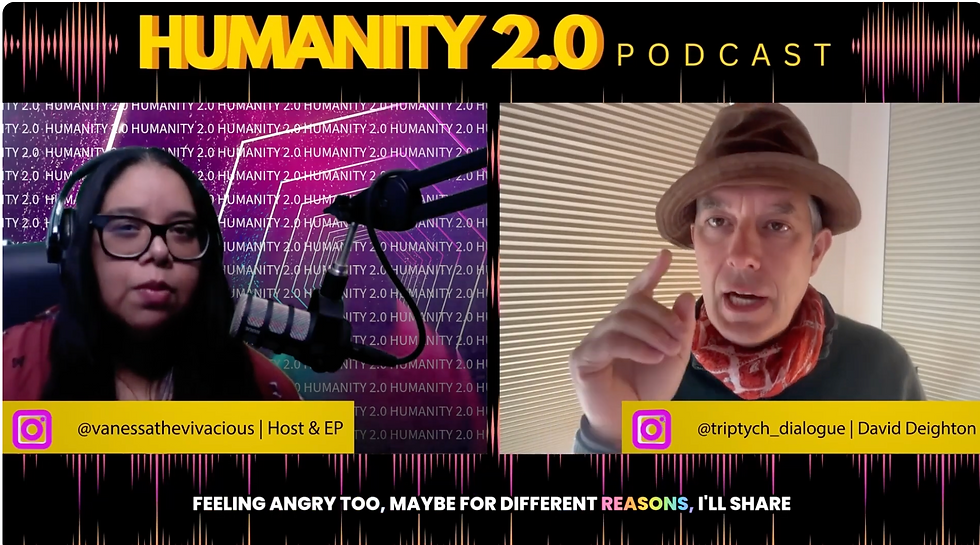
In this episode of the Cameron Journal Podcast, participatory conceptual artist David Deighton explores how contemporary art, public dialogue, and active listening can interrupt political polarization and reconnect people across ideological divides. Drawing from years of public installations, political conversations with strangers, and experiments with social media algorithms, Deighton explains why meaningful human interaction may be one of the most important forms of civic engagement today.
The conversation moves far beyond traditional political debate. Instead of focusing on winning arguments or correcting facts, Deighton discusses how vulnerability, sensory experience, and curiosity can create moments of shared humanity between people who fundamentally disagree. Through projects connected to Triptych Dialogue, Plato’s Allegory of the Cave, and participatory public art, he offers a radically different approach to communication in the digital age.
Key Takeaways
Active listening creates emotional bridges that facts and arguments often cannot.
Social media algorithms reinforce ideological isolation and discourage movement between communities.
Participatory art can function as a tool for civic engagement and public reflection.
Plato’s Allegory of the Cave remains a powerful metaphor for digital culture and algorithmic reality.
Meaningful political transformation may begin through curiosity, vulnerability, and face-to-face conversation.
The Limits of Political Debate and the Power of Active Listening
David Deighton’s work challenges one of the central assumptions of modern political discourse: that persuasion happens primarily through argument. Across hundreds of public encounters, he discovered that direct confrontation rarely changes minds. Instead, people become more open when they feel genuinely heard.
One of the core methods within Triptych Dialogue involves asking strangers three non-confrontational political questions inside participatory installations. Rather than debating policy or correcting misinformation, Deighton focuses on emotional states, shared frustrations, and the deeper human experiences beneath political identity. Participants frequently begin conversations expressing outrage but conclude with words such as “hope,” “unity,” or “community.”
This approach reframes active listening as both artistic practice and civic action. In a culture increasingly shaped by outrage-based media systems, Deighton argues that listening itself becomes a radical political gesture. The project demonstrates how slowing down conversation and remaining present can interrupt cycles of polarization.
Participatory Art as a Response to Digital Echo Chambers
Before beginning face-to-face installations, Deighton spent a year experimenting with political abstraction and public interaction on Instagram. During that process, he noticed how algorithms restricted movement between ideological communities. Simply attempting to engage outside his expected “artist” audience triggered repeated account restrictions and bans.
This realization became foundational to his broader critique of digital culture. Social media platforms reward ideological consistency, emotional outrage, and tribal reinforcement while discouraging curiosity across difference. In response, Deighton shifted away from anonymous online interaction toward physical public encounters in places such as Yellowstone National Park, the Grand Canyon, New York City, and rural communities.
His installations often visualize echo chambers physically. In one Grand Canyon installation, Deighton placed figures inside transparent containers representing rigid worldviews. Visitors were then asked how one person might move between these isolated perspectives. The simplicity of the question frequently generated long silences and deep reflection.
By turning abstraction into physical experience, participatory art becomes a tool for examining how individuals navigate ideology, media systems, and social division.
Plato’s Allegory of the Cave and the Search for Human Connection
Throughout the interview, Plato’s Allegory of the Cave emerges as one of the philosophical foundations behind Triptych Dialogue. Deighton frequently shares the allegory with students and participants as a metaphor for algorithmic life and digital perception.
In Plato’s story, prisoners mistake shadows on a cave wall for reality itself. Deighton compares this directly to contemporary online existence, where social media feeds shape emotional reality, political identity, and perception of others. However, he avoids framing the allegory in simplistic terms of “truth” versus “illusion.” Instead, he emphasizes movement — the ability to recognize when one is inside a particular worldview and develop enough flexibility to move between perspectives.
This idea of movement becomes central to his work. Human freedom, according to Deighton, does not necessarily come from fully escaping ideological systems, but from becoming conscious of them and maintaining the ability to question them.
As polarization deepens across both the United States and Europe, Deighton argues that rebuilding human connection may require a return to embodied conversation, shared physical spaces, and public vulnerability. In this sense, Triptych Dialogue operates not only as an art project, but also as an experiment in civic imagination.
Related Projects:
Discover face-to-face public conversations where strangers engage through listening, reflection, and non-confrontational political dialogue.
Explore the three-question framework developed to encourage respectful political exchange and deeper human understanding.
Discover participatory book interventions encouraging civic dialogue, curiosity, and public engagement beyond digital environments.
Explore sensory participatory books inviting slowness, awareness, listening, and reconnection through embodied experience.
Expert Quotes
“I realized that common ground doesn’t come through facts or opinions. It comes through emotion.”
“Listening itself becomes an act of kindness.”
“The important thing is fluidity — the ability to move between perspectives rather than remain trapped in one.”
FAQ Section
What is Triptych Dialogue?
Triptych Dialogue is an ongoing participatory art project by David Deighton exploring political polarization, active listening, public interaction, and human connection through installations, dialogue, and experimental media.
How does David Deighton use art to address political division?
Deighton creates public installations and structured conversations that encourage strangers to engage with one another through curiosity, vulnerability, and non-confrontational political questions rather than debate.
How does Plato’s Allegory of the Cave relate to social media?
Deighton uses Plato’s Allegory of the Cave as a metaphor for digital echo chambers and algorithmic perception, where people often mistake mediated information and emotional reinforcement for reality itself.
Host of Cameron Journal podcast:
Host of Cameron Journal, Cameron Cowan explores politics, culture, media, and society through long-form conversations focused on contemporary issues and human connection.
Edited Transcript:
Today on the Cameron Journal podcast, we are joined by David Deighton, an artist and educator using art to bridge political divides through public interaction, active listening, and participatory installations. Raised between French and American cultures and now living in the high desert of New Mexico, Deighton explores how polarization, social media, and digital echo chambers shape human relationships and public discourse.
Deighton explains that his work began with frustration over the increasing inability of people to discuss politics without anger or confrontation. He started bringing art installations into public spaces and speaking directly with strangers about politics to see what would happen. Surprisingly, he found that people rarely became hostile when approached face to face with genuine curiosity and active listening.
One of his recurring installations features two empty chairs labeled “Republican” and “Democrat.” Visitors are invited to sit down while Deighton mediates conversations through three non-confrontational political questions:
* How would you describe the political system of the United States?
* Describe your feelings about the current state of U.S. politics.
* Finish the sentence: “Politics in the United States is…”
Rather than focusing on facts or arguments, Deighton searches for emotional common ground. Participants often begin with frustration or anger but end conversations with words like “hope,” “unity,” “community,” or “democracy.” These responses later become material for future installations.
His work also expands active listening beyond speech. He asks sensory questions such as:
“What does democracy taste like?”
“What does fascism smell like?”
These unusual prompts interrupt habitual political thinking and encourage reflection through imagination and embodiment.
Deighton traces the origins of the project back to an experiment on Instagram where he posted abstract political videos exploring polarization and disinformation. While attempting to engage with communities outside his normal artistic circles — including alt-right groups — he found himself repeatedly restricted by platform algorithms. He realized that social media systems discouraged movement between ideological groups and rewarded remaining inside isolated digital bubbles.
That experience pushed him away from anonymous online engagement and toward face-to-face public encounters.
The conversation expands into broader reflections on social media, outrage, and human connection. Both Deighton and host Cameron Cowan discuss how algorithms amplify anger while reducing opportunities for meaningful dialogue. Cowan argues that people are slowly becoming aware of the manipulative nature of online platforms and may eventually seek deeper forms of in-person connection again.
Deighton responds that many people already long for reconnection and civility but often lack spaces or methods to engage across differences. He emphasizes the importance of vulnerability, questioning, and listening rather than debate or ideological victory.
Living in the American West, he observes how physically separated modern life has become. Cars, workplaces, restaurants, churches, and online communities often reinforce ideological isolation. He notes that France and Europe increasingly experience similar polarization despite traditions of public gathering and protest.
The discussion also turns toward the spread of political memes and digital propaganda. Deighton describes seeing identical meme structures circulating across countries and political ideologies, suggesting that many online conflicts are shaped by larger systems designed to intensify division.
As a substitute teacher in New Mexico public schools, Deighton frequently speaks with students about digital consumption and Plato’s Allegory of the Cave. He uses the ancient philosophical story as a metaphor for algorithmic life, where people become trapped staring at mediated illusions rather than engaging reality directly.
He explains to students that the goal is not necessarily to permanently “escape the cave,” but to become aware of movement between perspectives — to recognize when one is inside an echo chamber and develop the freedom to move between worlds, viewpoints, and communities.
One of his installations at the Grand Canyon visualizes this idea physically. A small figure sits inside a plexiglass museum case representing an echo chamber or worldview. Nearby, another figure exists inside a glass jar. Visitors are asked:
“How does one person move between these containers?”
The question often produces long silences and deep reflection.
Throughout the interview, Deighton argues that systemic social change begins not with domination or certainty, but with curiosity, vulnerability, and the willingness to ask questions. For him, the fluid space between opposing perspectives is where meaningful political and human transformation becomes possible.
At the end of the conversation, Deighton shares that he has largely left Instagram behind and now documents installations, interviews, and projects primarily through his YouTube channel and the ongoing Triptych Dialogue project.


Comments