
The Art of Listening: Why David Deighton’s Conversations Matter Now More Than Ever
- David Deighton

- May 16
- 7 min read
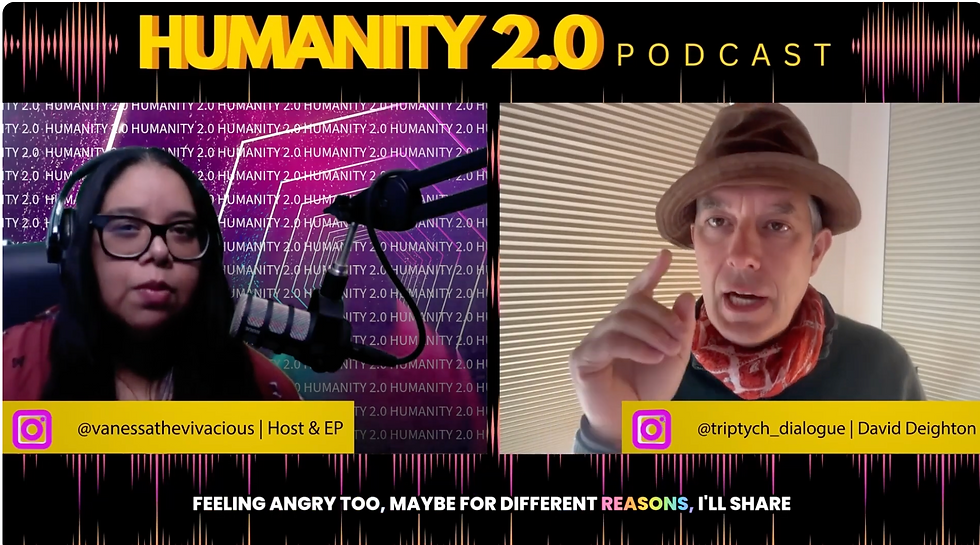
In a time defined by polarization, where political conversations often collapse into conflict, conceptual artist David Deighton offers a radically simple alternative: listen. In this compelling podcast appearance, Deighton reveals how his art practice transforms public spaces—especially national parks—into arenas for meaningful, non-confrontational political dialogue. His work is not about debate or persuasion, but about something far more rare: creating space for people to feel heard.
Listeners will gain insight into a unique artistic methodology that blends performance, social practice, and philosophy. From asking three carefully crafted political questions to discovering a single shared word that bridges differences, Deighton demonstrates how art can disarm tension, dissolve echo chambers, and reconnect individuals across ideological divides. This is not just an interview—it’s a blueprint for human connection in divided times.
Key Takeaways
Active listening is a powerful artistic and social tool that reduces conflict and builds trust.
Non-confrontational language unlocks dialogue, even around taboo topics like politics.
Shared emotional ground—not facts or opinions—is the true bridge between people.
Environment matters: neutral, natural spaces foster openness and connection.
Repetition and practice reduce emotional reactivity, enabling deeper, more meaningful exchanges.
The Power of Non-Confrontational Questions
David Deighton’s practice begins with structure. After early experiments with more provocative language, he refined his approach with the help of linguists to eliminate “trigger words.” The result: three neutral, open-ended political questions that invite reflection rather than defensiveness.
This subtle shift transforms the interaction. Instead of bracing for argument, participants find themselves unexpectedly safe to express their thoughts. The questions act less like prompts and more like permission—permission to articulate ideas that often remain suppressed in everyday life. In a culture where political discourse is frequently avoided or explosive, this neutrality becomes a powerful catalyst.
By removing confrontation from the equation, Deighton reframes political dialogue as exploration rather than opposition. The goal is not to win, but to reveal.
Art as a Bridge Between Emotional Worlds
At the core of Deighton’s work is a deceptively simple idea: connection happens through shared emotion, not agreement. After each conversation, he asks participants to distill their thoughts into a single word—often something like “hope,” “anger,” or “frustration.”
This word becomes the bridge.
Rather than debating facts or ideologies, Deighton meets participants in that emotional space. Even when viewpoints clash, the recognition of shared feeling creates a moment of alignment. It’s a shift from “you vs. me” to “we both feel this.”
He extends this concept further through sensory exploration—asking questions like “What does democracy taste like?” These unexpected prompts disrupt linear thinking patterns, encouraging participants to engage with abstract ideas in new, embodied ways. The result is not just conversation, but transformation.
Breaking Out of the Echo Chamber
Deighton’s installations often function as metaphors for modern isolation. Whether through a plexiglass display case or a jar containing a figurine, he illustrates the concept of the “echo chamber”—a confined worldview that feels expansive from within but is inherently limited.
His work challenges participants to step outside these invisible boundaries. Projects such as his Views from the Cave project can be explored for deeper understanding of the overall work.
By engaging strangers in neutral environments like national parks, Deighton creates what he describes as “low-threat contact zones.” These spaces lack the urgency and suspicion of urban environments, allowing conversations to unfold organically. The setting becomes as important as the dialogue itself.
Through repeated encounters, Deighton has observed a consistent pattern: people want to be heard. Many participants express relief—even emotion—at finally having space to share their thoughts without interruption or judgment. In this way, his work exposes a profound gap in contemporary society: the absence of genuine listening.
Related Projects:
Explore how attentive listening, emotional restraint, and presence became foundational practices within Triptych Dialogue and public conversation projects.
Discover face-to-face public conversations where strangers engage through listening, reflection, and non-confrontational political dialogue.
Explore the three-question framework developed to encourage respectful political exchange and deeper human understanding.
View participatory public art interventions developed within designated First Amendment areas of U.S. National Parks.
Explore sensory participatory books inviting slowness, awareness, reflection, and reconnection beyond digital environments.
Examine the movement away from digital echo chambers toward embodied conversation, public interaction, and human connection.
Expert Quotes
“I’m not looking for agreement—I’m looking for a word we share.”
“People don’t need to be corrected. They need to be heard.”
“The bridge isn’t in facts or opinions—it’s in emotion.”
FAQ
What are David Deighton’s three political questions?
They are carefully designed, non-confrontational prompts that invite reflection on the U.S. political system, personal reactions to politics, and a final open-ended statement about politics.
Why does David Deighton focus on strangers?
Strangers offer a unique opportunity for honest dialogue without the baggage of existing relationships. This creates a safer space for open expression.
How does this approach reduce political polarization?
By prioritizing listening over debate and focusing on shared emotions, Deighton’s method bypasses ideological conflict and fosters human connection.
Podcast Host Bio
David Beckemeyer
Outrage Overload delivers clear analysis, expert conversations, and live events that help you recognize manipulation, sharpen your thinking, and stay grounded in modern politics.
Edited Transcript
I’m David Deighton. I’m a conceptual and abstract artist, and I do something unusual: I go into national parks to meet strangers and talk directly about the taboo subject of politics. I’ve never had an argument doing this. I actively listen, record what people say, and express it through different artistic forms. I usually find one word that connects us—it might be an emotion or shared reaction—and use that as a bridge. It works. I’m still here.
People respond to being heard. Many aren’t used to it. Some have cried because it was their first real opportunity to express their political thoughts without being shut down. They’ve experienced broken relationships with family and friends and avoid political conversations altogether. In these unexpected moments, strangers open up in public spaces, releasing something they’ve been carrying for a long time.
I started with my own questions, but they were unintentionally polarizing. With help from linguistics experts, I developed three neutral, non-confrontational questions that invite dialogue regardless of political stance. They allow people to express themselves freely without triggering defensive reactions.
From an artistic perspective, taboo subjects are obstacles to creativity. If people feel they can’t talk about something, that’s exactly where I want to go. I want to create space for expression, especially around politics, because open, civil conversation is foundational to democracy. I began this work online with a year-long project exploring disinformation and polarization, but after being repeatedly banned for reaching across different groups, I moved into physical spaces.
I now work in person, often in national parks, using these three questions as my canvas. I listen without interrupting or preparing a rebuttal. I identify a shared word—often something like anger, frustration, or hope—and use it to build connection. It’s not about facts or opinions; it’s about recognizing shared human experience.
I expand this idea through different artistic methods. I create books with these questions and leave them in public spaces. I bury time capsules with political messages in the desert. I build installations that invite interaction. One example involves asking people what concepts like “democracy” taste or smell like. This shifts them into a different mode of thinking. They pause, reflect, and engage their senses in unexpected ways, which reduces emotional reactivity and opens up new interpretations.
My goal is simple: to get people talking to one another, especially outside their usual circles. When people engage with strangers, they often discover unexpected common ground. We may not agree on facts or opinions, but we can connect through shared emotions and experiences.
In my encounters, I’ve noticed patterns. Despite differences, many people express hope for the future. There is also a strong need to speak openly about topics society discourages. People want civility. They want to be heard. And when given the chance, they engage respectfully.
Creating a low-threat environment is key. The questions are neutral, and the setting matters. Natural spaces like national parks provide a calm, open atmosphere where people are more willing to engage. Unlike busy city streets, these environments allow for presence and reflection. I often start by helping someone take a photo, then begin a conversation.
I also use objects and installations as conversation tools. For example, I display a glass case like a museum exhibit. Inside is an object, but the real focus is the case itself. It represents our worldview—our echo chamber. We think we see everything clearly, but our perspective is limited. I also use a small jar with a figure inside to represent a more confined echo chamber. Then I ask: how do these separate worlds communicate with each other?
That question often leads to silence and reflection. People think deeply about it. The answer isn’t simple, but the act of considering it is meaningful. It becomes a story they carry forward and share with others.
Through repetition and practice, I’ve changed as well. Early on, I was easily triggered by certain language or viewpoints. Over time, hearing these perspectives repeatedly allowed me to detach from the emotional reaction and focus on the person behind the words. The anger fades, and understanding grows.
Now, I can have dozens of conversations in a day. Many are brief—just a minute or two—but they matter. Some go deeper. Most people don’t ask questions back, but they take the experience with them and use it elsewhere. That’s enough.
This work is about presence, listening, and connection. It’s about stepping outside our own echo chambers and engaging with others. It can be uncomfortable, but it’s also transformative. Every interaction adds to a larger, collective effort to understand one another.
For me, this is both an artistic practice and a form of activism. Every intentional action is part of a larger work of art—one we’re all creating together.


Comments